

Are you a parent in Ohio considering homeschooling for the first time? You’re not alone, and starting this journey can be both exciting and overwhelming. This friendly guide will walk you through everything you need to know – from Ohio’s legal requirements, to picking a curriculum, to scheduling tips – so you can begin homeschooling with confidence. Homeschooling in the Buckeye State offers flexibility and the chance to tailor learning to your child’s needs, all within a supportive legal framework.
Key Points: Starting homeschooling in Ohio is simpler than many parents expect. To begin, you must submit a notice of intent to your local superintendent by August 30 (or within 5 days of starting), confirm you’ll teach the required subjects, and then your child is immediately exempt from compulsory school attendance. Ohio no longer requires testing, portfolios, teacher qualifications, or 900-hour logs, giving families full flexibility. From there, your biggest decisions are choosing a curriculum (boxed program, online options, or mix-and-match) and building a schedule that fits your home life—most families focus on core subjects in the morning and keep afternoons for projects, breaks, and enrichment.
Understanding Ohio Homeschool Laws and Requirements
Ohio has homeschool-friendly laws, but there are a few key requirements you must follow. In 2023, Ohio updated its homeschool law (House Bill 33), making it simpler for families. Here’s what you need to know about complying with Ohio’s legal requirements:
- Notify the Local Superintendent: You must submit a notice of intent to homeschool to your local school district superintendent. This notice is due by August 30 each year, or within 5 days of starting your homeschool program or withdrawing your child from school. The notification should include your name and address, your child’s name, and an assurance that you will teach the required subjects. (Many districts have a form or template for this notice – check your district’s website or the Ohio Department of Education’s resources.)
- Teach the Required Subjects: Ohio law requires that homeschoolers cover certain core subjects. These include English language arts, mathematics, science, history, government, and social studies. You have the freedom to decide how to teach these topics (more on curriculum below), but make sure your plan touches on each of these areas throughout the year.
- Know Your Child Is Exempt: Once your superintendent receives your notice, your child is exempt from compulsory school attendance immediately. The superintendent will send you a written acknowledgment within 14 days, but you do not have to wait for an “approval” to start homeschooling – Ohio law automatically recognizes your right to home educate.
- No Assessments or Hour Logs Required: Unlike some states, Ohio no longer requires homeschoolers to submit test scores or portfolio reviews to the district. Recent changes also eliminated the old requirement of 900 hours of instruction per year, giving families more flexibility. There are no teacher qualification requirements either – parents do not need a teaching license or college degree to homeschool their children in Ohio.
Important: Homeschooling means taking full responsibility for your child’s education. Ohio’s law trusts parents with this freedom, but it also expects that children will be educated. If there were evidence that a child isn’t being taught (for example, missing from education entirely), authorities could investigate. As long as you’re providing instruction in the required subjects, you’re doing fine. Now, let’s look at how to choose a curriculum for those subjects.
Choosing or Building Your Homeschool Curriculum
One of the biggest perks of homeschooling in Ohio is curriculum freedom. There is no state-mandated curriculum – parents are completely responsible for choosing the curriculum and course of study for their children. This means you can select resources that fit your child’s learning style, your educational philosophy, and your family’s schedule. It’s normal for new homeschoolers to feel overwhelmed by the choices, so here’s some guidance:
- Follow Ohio’s Learning Standards as a Guide: While you can teach in the way that suits your family, you might wonder what to teach. The Ohio Department of Education recommends using Ohio’s academic content standards as a guide when developing your curriculum. These standards outline what students typically learn in each grade for each subject. You don’t have to strictly adhere to them, but they can help ensure you’re covering age-appropriate skills (for example, what math topics are usually covered in 3rd grade).
- Choose an Approach or Program: There are many ways to homeschool, from structured programs to a more eclectic mix. Some families purchase a complete boxed curriculum from well-known providers (e.g. Sonlight, Abeka, or BJU Press) that include lesson plans and materials for all subjects. Others opt for online programs (such as Time4Learning or free resources like Khan Academy) that allow children to learn at their own pace. You can also mix and match – use a specific math textbook you like, a different source for history, and so on. Homeschooling allows you to be creative and tailor the education to your child.
- Sample Recommended Resources: To get started, consider checking out resources recommended by experienced homeschoolers. For instance, All-in-one programs provide structure if you’re nervous about lesson planning, whereas unit studies or project-based learning let you build a custom curriculum around your child’s interests. Don’t forget your local library – libraries are goldmines for books, educational kits, and even free classes or events. Additionally, local or online homeschool groups in Ohio (for example, co-ops or Facebook groups) often share curriculum reviews and can offer advice on what works best.
- Adjust as You Go: Remember, your first choice of curriculum isn’t set in stone. If a math program isn’t working well or a history book is too dry, you have the flexibility to try something else mid-year. Homeschooling involves some trial and error for every family. Over time, you’ll discover what engages your child and fits your teaching style. The ultimate goal is to cover the required subjects in a way that your child learns effectively, whether that’s through textbooks, hands-on experiments, educational games, or field trips.
(Friendly reminder: Ohio provides no financial assistance for homeschool curriculum, so budget accordingly. Save receipts for educational materials – Ohio now offers a homeschool tax credit up to $250, which might help offset some costs.)
Scheduling Tips for Homeschooling in Ohio
One question new homeschooling parents often ask is, “What should our daily schedule look like?” The answer is that homeschool schedules can be as flexible as you need them to be. Without a school bell or a mandated 900-hour calendar, you have the freedom to design a routine that works best for your child and family life. Here are some tips and ideas for creating a homeschool schedule:
- Start with a Consistent Routine: Kids thrive on routine. Set a general start time for your homeschool day – many families begin around the same time regular school would, such as 8:30 or 9:00 AM. Consider tackling core subjects (like math and language arts) in the morning when your child is freshest. You might be surprised how efficiently you can cover material one-on-one at home; a few focused hours in the morning can accomplish what might take a full day in a classroom. Many Ohio homeschoolers find that they finish formal lessons by early afternoon, leaving the rest of the day for free play, hobbies, or extracurricular activities.
- Be Flexible and Adaptable: While a routine is helpful, homeschooling does not have to follow a rigid 8am-3pm schedule. Life happens – appointments, sick days, or simply an unexpected sunny day that beckons you outside. Give yourself permission to be flexible. One experienced mom of nine put it this way: “Flexibility is absolutely key to your happiness and your children’s happiness.” If a planned lesson isn’t clicking, you can pause and revisit it later. If your child is engrossed in an art project or a great book, you can allow them to dive deep without watching the clock. Homeschooling in Ohio allows you to structure learning time and break times in the way that reduces stress and maximizes learning.
- Consider a Four-Day Week or Year-Round Schooling: Another scheduling freedom you have is setting your school year. Some families choose a traditional schedule (following roughly August–May with summers off), while others do year-round schooling with shorter, more frequent breaks. There’s also the option of a four-day school week, using the fifth day for field trips, co-op classes with other homeschoolers, or catch-up time. For example, you might do academics Monday through Thursday, then use Friday for fun learning experiences like visiting the Ohio Science Center, a local historical site, or a park nature program. Find a rhythm that prevents burnout and keeps your child engaged.
- Include Breaks and Downtime: Don’t forget to schedule breaks, lunch, and free time into your day. Homeschoolers can get a lot done in a short time, but kids still need downtime to process and relax. A good rule of thumb is to take a short break after each hour of study or whenever you notice your child losing focus. Younger kids especially benefit from movement between lessons – a quick snack or 15 minutes of play outside can recharge everyone’s batteries. Homeschool also allows kids to sleep a bit later if needed and work at the time of day they learn best (for some teens, that might be later in the day). Use that flexibility to your advantage.
Closing Thoughts: Ohio To All!
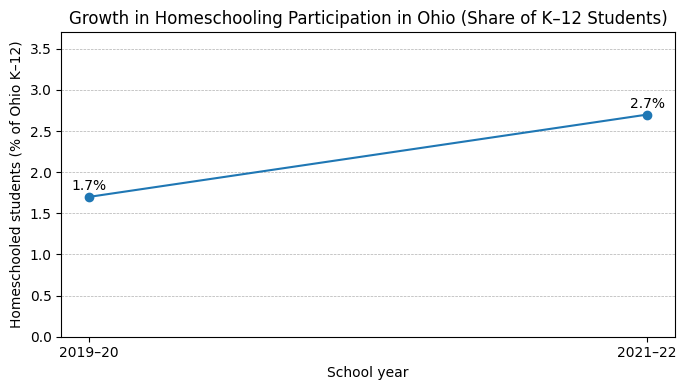
Starting homeschooling in Ohio is a big step, but remember: you are capable and you are not alone. Ohio’s homeschool community is growing, and there are many resources and fellow parents out there eager to help. To recap, make sure you’ve taken care of the legal basics (notification and an outline of subjects), choose a curriculum approach that fits your child, and create a schedule that turns learning into an enjoyable part of your family’s daily life.
Most importantly, keep a positive, patient attitude. There will be amazing days where everything clicks, and there will be hard days – that’s normal! Through it all, you’ll be building a special learning experience tailored to your child. As a next step, you might want to reach out to local homeschool groups or co-ops for support and social opportunities, or visit the Ohio Department of Education’s Homeschooling FAQ page for any additional questions you have.
Homeschool FAQ:
No. Once you submit your notice of intent, your child is exempt from compulsory attendance—you don’t need formal “approval” to begin.
Homeschool programs should cover core areas like English language arts, math, science, history, government, and social studies.
No. Ohio no longer requires annual assessments, test scores, or portfolio reviews for homeschool families.
 English