
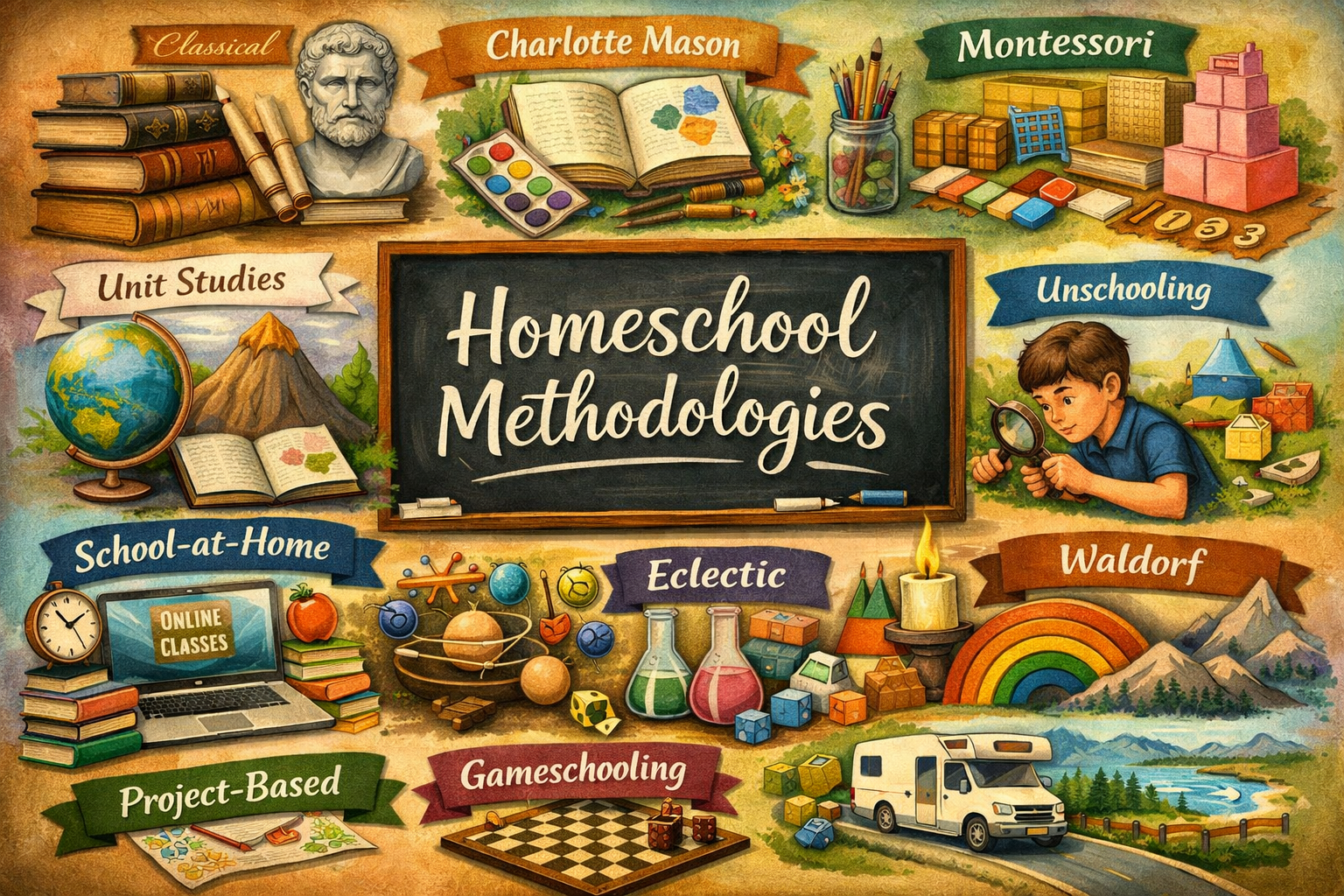
Homeschooling used to be the exception. Today it’s a growing movement, a flexible option that families across Canada and beyond are exploring for a variety of reasons like academic freedom, better work–life balance, dissatisfaction with local schools, travel opportunities or special needs. Whatever the motivation, nearly everyone who starts this journey runs into the same question: which homeschool methodology is right for us?
Like any good journey, the road to homeschooling success is paved with research, experimentation and self‑reflection. Homeschool methodologies refer to the underlying philosophies and structures that shape what learning looks like day to day. They range from highly structured, classical approaches to free‑form, child‑led experiences. Understanding the landscape helps parents pick a path that fits their children’s personalities and their family’s lifestyle.
Methodology Is Your Foundation
Not all children (or parents!) thrive under the same structure. Some kids love open‑ended exploration; others find security in a clear schedule. Knowing the major methods helps you evaluate options and, if necessary, blend elements into your own personalized style. Many families start with one approach and gradually adapt as they discover what sparks curiosity and engagement.
1. Classical Education
Overview: The classical model is rooted in ancient Greek and medieval education. It divides learning into three stages known as the trivium, grammar, logic and rhetoric. In the grammar stage (roughly elementary years), children focus on memorizing facts and building foundational knowledge. The logic stage (middle years) emphasizes reasoning and critical thinking. Finally, the rhetoric stage (high school) develops communication skills and persuasive writing. Classical curricula often include Latin, logic, philosophy and great literature.
Pros:
- Builds strong thinking and communication skills.
- Emphasizes classic literature and historical texts.
- Provides a time‑tested, structured approach.
Cons:
- Can be intense or overwhelming, especially in the upper levels.
- Heavy parent involvement is needed, particularly in early years.
- May feel too rigid for creative or struggling learners.
Best for: Families seeking academic rigor and a literature‑rich education. Children who enjoy reading, analyzing and discussing ideas often thrive under this model.
Key take‑away: The classical method cultivates a love of truth, goodness and beauty while systematically developing reasoning skills. Its tri‑phase structure offers clarity and a sense of continuity with thinkers from the past.
2. Charlotte Mason Method
Overview: Named after the 19th‑century British educator Charlotte Mason, this approach champions living books (well‑written, story‑rich texts) instead of dry textbooks, short lessons, nature study and habit training. Children learn through narration, retelling stories in their own words, and spend time outdoors observing and journaling about nature. Art and music appreciation are integrated, and lessons remain gentle yet meaningful.
Pros:
- Cultivates curiosity and a love of learning.
- Encourages character development and good habits.
- Uses short lessons, which can fit well with young children’s attention spans.
Cons:
- May feel too “soft” for academically driven families.
- Requires hands‑on time from parents for narration and nature walks.
- Finding high‑quality living books can be challenging.
Best for: Families who value a cheerful, beauty‑in‑simplicity approach to education. Creative, sensitive or nature‑loving children often flourish with Charlotte Mason methods.
Key take‑away: Mason’s philosophy respects children as persons. Her motto “Education is an atmosphere, a discipline, a life” emphasizes the integration of knowledge, habit and inspiration.
3. Montessori Homeschooling
Overview: The Montessori method, developed by Italian physician Maria Montessori, is hands‑on and child‑directed. In a Montessori home, children choose activities from a prepared environment filled with tactile materials that teach practical life skills and academic concepts. Learning is tied to real‑life tasks, and freedom within boundaries fosters independence. Parents act as facilitators rather than instructors.
Pros:
- Promotes independence and confidence.
- Encourages natural curiosity and responsibility through self‑paced exploration.
- Emphasizes practical life skills and order.
- Allows flexibility and customization to meet individual needs.
Cons:
- Requires specific materials and setup, which can be costly.
- May be difficult to implement without training or community support.
- Less commonly used in older grades; adaptation is often needed for high school.
Best for: Independent learners and families who value hands‑on learning and freedom within limits. The method is especially popular for preschool and early elementary students.
Key take‑away: Montessori homeschooling combines self‑directed learning with a carefully prepared environment, encouraging children to take responsibility for their education and develop critical thinking and problem‑solving skills.
4. Unit Studies
Overview: In the unit‑study approach, families choose a theme (e.g., oceans, farming or ancient Egypt) and weave that theme through multiple subjects such as science, history, literature, art and math. For example, a unit on farming might include reading E. B. White’s Charlotte’s Web, constructing a farm‑animal diorama, visiting a farm, studying animal classification and writing a poem from a farmer’s perspective. Learning feels cohesive and often involves hands‑on projects.
Pros:
- Highly engaging and adaptable.
- Encourages deep understanding by connecting ideas across disciplines.
- Allows the whole family to learn together, with children working at their own levels.
Cons:
- Preparing or designing units can be time‑consuming unless using pre‑made studies.
- May miss systematic skill‑building in areas like grammar or math without supplementation.
Best for: Families with multiple children in different age ranges and kids who enjoy thematic learning and creative projects.
Key take‑away: Unit studies encourage curiosity and make learning feel relevant by connecting academic concepts to real‑world experiences. They work well for project‑based learners and families seeking a collaborative approach.
5. School‑at‑Home
Overview: The school‑at‑home method replicates the structure of public or private school in the home. Families often have a dedicated school room with a bulletin board, whiteboard or chalkboard and follow a structured daily schedule. Some parents enroll their children in online public or charter schools to mirror their peers’ curriculum and standardized testing.
Pros:
- Provides predictable schedules and pre‑planned curriculum, easing the transition from conventional schooling.
- Helps ensure alignment with state or provincial standards and keeps children on track academically.
- Suitable for parents with backgrounds in teaching who prefer familiar methods.
Cons:
- Lacks the flexibility that draws many families to homeschooling.
- Can feel rigid and may not accommodate varied learning styles.
- Replicates school stressors (deadlines, tests) without necessarily improving engagement.
Best for: Families new to homeschooling who feel more comfortable with a familiar structure and parents who appreciate having a ready‑made curriculum. It also supports families needing to adhere closely to school standards while learning at home.
Key take‑away: School‑at‑home is the most traditional homeschool style. It offers structure and accountability but sacrifices some of the autonomy that makes homeschooling unique. Many families use it temporarily before transitioning to a more personalized approach.
6. Eclectic Homeschooling
Overview: Eclectic homeschooling is a personalized blend of whatever works best. Parents mix and match elements from different methodologies, classical math with Charlotte Mason reading, unschooling for science with unit studies for history, and a few online courses for good measure. It’s “not a predefined method that follows a certain philosophy,” but rather a practice‑driven approach that emerges as parents experiment.
Benefits:
- Completely personalized education that adapts to each child’s strengths and weaknesses.
- Allows parents to select evidence‑based practices from various curricula while discarding what doesn’t work.
- Can be cost‑effective and scalable for families with multiple children.
- Particularly beneficial for children with special needs because it enables extensive customization.
Drawbacks:
- Requires significant research and planning to assemble resources and ensure coherence.
- Parents must develop expertise across subjects and philosophies, which can be overwhelming.
- It may take time to discover what works; families often adjust repeatedly before finding a comfortable rhythm.
Best for: Families who want maximum flexibility or have tried multiple methods and desire a customized blend. It appeals to parents teaching children with different learning styles and those seeking to tailor education to each child’s interests.
Key take‑away: Eclectic homeschooling is both liberating and demanding. It empowers families to craft a unique learning experience but requires intentional planning and ongoing reflection to maintain balance.
7. Unschooling
Overview: Unschooling isn’t a curriculum at all; it’s a philosophy that trusts children’s intrinsic motivation to learn. John Holt, an educator and author, coined the term in the 1970s to suggest learning free from school structures. Unschoolers believe children are “hard‑wired to learn” and that learning arises from play, curiosity and pursuing passions. Parents act as facilitators, connecting children with resources and opportunities rather than directing lessons.
Core beliefs:
- Children are naturally curious: They constantly explore their world like “infant scientists”.
- Interest drives learning: When people care about a topic—whether it’s gluten‑free cooking or insects—the drive to learn becomes effortless.
- Learning is a by‑product of living: Vocabulary, reading and other skills develop as tools for pursuing interests.
- Parents are facilitators, not teachers: Their role is to connect children with resources and experiences, not design lessons.
Who it fits: Parents who dislike routine, trust children’s internal rhythms and have flexible schedules. It appeals to families who believe education should be child‑led and free from coercion. The unschooling lifestyle can foster self‑reliance and critical thinking.
Challenges:
- Unschooling can feel unstructured or aimless to newcomers.
- Documentation for regulatory compliance may be harder.
- It requires a high level of trust and adaptability from parents; there’s no one‑size‑fits‑all blueprint.
Key take‑away: Unschooling is less a method than a mindset. It invites families to let curiosity drive education and to see learning as an organic part of life rather than a series of lessons.
8. University Model (Hybrid Homeschool)
Overview: Also known as the University Model or Hybrid Homeschool, this structure combines traditional schooling with home education. Students attend a private or co‑operative school for two or three days a week and complete assignments at home under parental supervision on the remaining days. Class sizes are typically smaller than in public schools, offering more one‑on‑one attention.
Pros:
- Provides professional instruction and extracurriculars while preserving time at home.
- Helps prepare students for college schedules and study habits.
- Offers a “best of both worlds” approach: school community and parental influence.
Cons:
- Tuition and fees can be comparable to private school.
- Families must coordinate their schedules with the hybrid school’s calendar.
- Less flexibility compared with pure homeschooling.
Best for: Families who want professional academic guidance but cannot commit to full‑time homeschooling due to work or other responsibilities.
Key take‑away: The University Model provides a structured, college‑preparatory environment while allowing parents to remain involved in their children’s education. It’s a good compromise for families needing accountability and social opportunities.
9. Project‑Based Homeschooling
Overview: In project‑based homeschooling, learners explore real‑world topics through in‑depth projects. Research, analysis, building and presenting become central activities. The approach nurtures problem‑solving and collaboration skills. Projects may be student‑led, encouraging ownership and creativity.
Pros:
- Develops critical thinking and collaboration skills.
- Encourages students to connect multiple subjects naturally.
- Makes learning engaging and meaningful through real‑world application.
Cons:
- Lack of structure requires careful planning and patience.
- May not cover every academic skill unless supplemented.
Best for: Learners who enjoy exploring topics deeply and families who want an experiential, student‑led environment.
10. Waldorf Homeschooling
Overview: Waldorf education, created by Austrian philosopher Rudolf Steiner, takes a holistic approach that engages the head, heart and hands. It emphasizes rhythm, imagination, storytelling and creativity; the arts are woven into every subject. Steiner identified developmental stages (0–7, 7–14, 14–21) and tailored the curriculum accordingly. The method delays formal academics, focusing on oral stories, movement and hands‑on work in the early years.
Pros:
- Combines academics with art, making learning memorable.
- Encourages imaginative thinking and a vivid inner life.
- Fosters cooperation rather than competition.
- Values nature and seasonal rhythms, promoting balance and emotional intelligence.
Cons:
- Delayed academics may concern some families.
- Quality materials can be expensive and the emphasis on arts may not suit all children.
- The spiritual roots of anthroposophy and limited technology use are controversial for some families.
Best for: Families seeking a holistic, art‑rich education and those who value storytelling, mythology and nature. Learners who thrive on creative expression often enjoy Waldorf homeschooling.
Key take‑away: Waldorf education promotes experiential learning that balances intellectual, emotional and physical development. Its emphasis on rhythm and the arts can create a nurturing, soulful atmosphere.
11. Roadschooling
Overview: Roadschooling turns the world into a classroom. Families travel—whether across Canada, through North America or around the globe—using museums, national parks, historical sites and cultural experiences as the curriculum. Parents plan travel logistics and guide learning along the way.
Pros:
- Makes learning exciting and relevant by immersing children in real‑world contexts.
- Provides cultural exposure and adaptability.
- Encourages family bonding and creates memorable experiences.
Cons:
- Requires flexible planning, a travel budget and a willingness to live on the road.
- Limited access to local community resources and long‑term friends.
Best for: Adventurous families who value experiential learning and have the means to travel. It appeals to learners who thrive on novelty and exploration.
12. Gameschooling
Overview: Gameschooling uses board games, card games and digital games as primary educational tools. Facilitators design game‑based activities to make learning interactive and low‑pressure. Subjects from math to history can be covered through strategy games, simulations and role‑playing.
Pros:
- Great for family bonding and social skills.
- Builds critical thinking and problem‑solving.
- Makes learning engaging and helps reluctant learners participate.
Cons:
- Progress is harder to measure compared with traditional assignments.
- Needs balance with deeper study to ensure comprehensive coverage.
- Can become overly recreational if not intentionally designed.
Best for: Children who dislike textbooks or traditional methods and families looking for a playful, relationship‑centered approach.
How to Choose the Right Homeschool Method
- Know Your Child: Consider whether your child prefers structure or spontaneity, independence or guidance, and what sparks their curiosity. Recognizing learning styles—visual, auditory, kinesthetic—also helps tailor methods.
- Know Yourself: Reflect on your teaching preferences and time availability. Are you more relaxed or scheduled? How confident are you in planning lessons? Your comfort level matters because your enthusiasm will affect your child’s attitude.
- Try and Adjust: Start with a style that feels right, but give yourself permission to adapt over time. Many families evolve as they discover what sparks joy and curiosity for their children.
- Don’t Chase Perfection: No method is flawless. The best method is the one that works right now. Seasons of life may call for structure; others demand flexibility.
- Start Small: Sample lessons, test unit studies or mix and match a few methods before committing. Creating a dedicated learning space—whether a table, corner or entire room—can help set the tone.
- Reflect on Values: Ask what educational values matter most—faith, critical thinking, creativity, life skills or academic rigor—and pick methods that align.
Final Thoughts
Choosing a homeschool methodology is both an art and a science. It requires knowledge of educational philosophies and a deep understanding of your children and yourself. The good news is that homeschooling is inherently flexible. Many families start with one approach and gradually weave in elements of others, creating a rich tapestry tailored to their needs. Whether you embrace the structured beauty of classical education, the gentle rhythms of Charlotte Mason, the self‑directed freedom of Montessori, the imaginative wonder of Waldorf, the adventure of roadschooling or a personalized eclectic blend, the goal remains the same: to cultivate a lifelong love of learning and a family culture rooted in curiosity, connection and growth.
Remember, there’s no universal “best” approach. The best method is the one that supports your child’s growth, honors your family’s values and keeps learning joyful and meaningful. Stay curious, be flexible and enjoy the journey.
 English